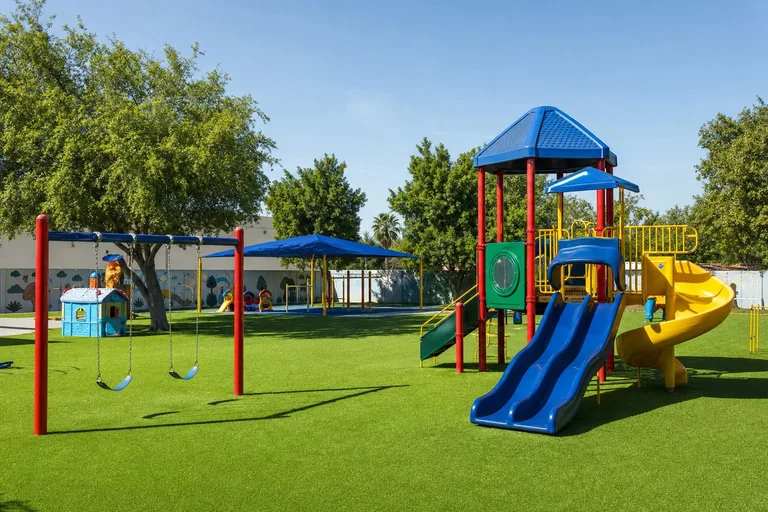
Summary: High-traffic play areas wear natural grass into mud and bare dirt, and Tulsa rain makes it worse. Artificial turf gives backyards, daycares, churches, and schools a clean, even surface that drains fast and stays usable year-round. Turf can be designed around cushioning and drainage needs for the project. T-Town Turf builds the base and surface for heavy use and Oklahoma weather.
The short answer
Artificial turf gives Tulsa play areas a clean, even, mud-free surface that holds up to constant use and dries fast after a storm. For backyards, daycares, churches, and schools, it removes the worn dirt patches, puddles, and tracked-in mud that come with natural grass in high-traffic play zones. Turf can also be designed around cushioning, drainage, and use needs for a given project. The right system comes down to the base and the build, and T-Town Turf installs recreation turf for Tulsa weather and heavy foot traffic.
The core idea: play areas take more abuse than any lawn. A surface that stays clean, even, and drains fast comes from the base and build, not the blades. T-Town Turf engineers both for the way kids actually use the space.
Why natural grass struggles in play areas
Play zones concentrate foot traffic in a small space, and natural grass cannot keep up. Swings and slides wear the grass down to bare dirt, running paths turn to ruts, and every Tulsa rain leaves puddles and mud that come inside on shoes and clothes. Reseeding rarely takes in a high-use area, so the worn spots only spread. Artificial turf replaces that cycle with a surface that stays green and even no matter how much it is used, which is why so many Tulsa families and organizations choose it for play areas.
What turf does for a play space
The benefits stack up quickly once the mud and bare spots are gone. The grid below shows what matters most for a Tulsa play area.
No more mud
Play areas stay clean and usable after Tulsa rain instead of turning into a mud pit that tracks indoors.
Soft, even footing
A consistent surface with no holes, ruts, or bare dirt, and turf can be designed around cushioning needs for the project.
Drains fast
Storm water passes through the perforated turf and permeable base, so kids are back outside soon after the rain stops.
Low maintenance
No mowing, watering, reseeding, or muddy patches to repair, just an occasional brush and rinse.
That clean, fast-draining performance comes from the same drainage-first approach behind every quality install. Our guide on turf drainage for Tulsa clay soil explains why the base is what makes water move.
Estimate savings, value, and quality of life before you plan.
Use T-Town Turf's calculator to compare lawn upkeep costs, turf plus outdoor amenity value, and the time a cleaner, lower-maintenance Tulsa property could give back.
Safety and cushioning considerations
A common question for play areas is cushioning. Artificial turf can be designed around padding and use needs, and there are systems built to add a cushioning layer beneath the turf for play zones. The right approach depends on the project, the equipment, and how the space is used, so the best step is to talk through your goals during a consultation. T-Town Turf will walk through cushioning, drainage, and surfacing options with you and recommend what fits your space rather than promising a one-size-fits-all spec. If your project has specific impact or fall-zone requirements, bring those to the consultation so the design can be planned around them.

Where playground turf works in Tulsa
Recreation turf fits a wide range of spaces. In backyards it gives kids and dogs a clean, soft area that ties into the rest of the yard. For daycares and preschools it means a dependable surface that stays usable between groups. Churches and schools use it for play areas and high-traffic gathering spots that natural grass cannot maintain. Many of these projects pair play turf with pet-friendly turf or a broader outdoor-living design so the whole space works together. T-Town Turf handles commercial and organizational installs as well as residential play areas.
Why the install matters for play areas
Play areas punish shortcuts. Skip the drainage and you get puddles where kids gather; under-compact the base and the surface ripples under constant traffic; skip the barrier and weeds push through. These are the same failures that show up on DIY jobs, which we cover in our guide on DIY vs professional turf installation in Tulsa. T-Town Turf grades the space, builds a permeable base, adds the barrier, and finishes with turf and infill suited to heavy use so the play area performs for years.
The T-Town Turf approach
A play area that stays clean and even comes down to drainage, a stable base, and turf suited to heavy use, with cushioning planned around the project. As a locally owned Tulsa company, T-Town Turf designs each play space for how it is actually used, then walks the finished project with you. Here is how a typical install comes together:
- 1
Free on-site consultation
We look at how the space is used, the traffic, drainage, and any cushioning or fall-zone goals you have, then recommend a surfacing approach for the project.
- 2
Custom plan and transparent quote
You get a clear scope and price with no surprises. We also know most common HOA and property expectations and can help you navigate the questions to ask, though final approval always depends on your specific HOA, owner, or manager.
- 3
Grading and permeable base
We grade for slope and compact a free-draining base so rain moves down and away instead of pooling where kids play.
- 4
Cushioning, barrier, turf, and infill
Where the project calls for it we build in a cushioning layer, then add the weed barrier, seam and secure the turf, and brush in infill suited to heavy use.
- 5
Final walkthrough
We inspect drainage, seams, and edges with you so the play area is ready for constant use and built to stay clean and even.
Ready for a play area that stays clean and usable? See T-Town Turf's playground and recreation turf or reach out to our local team for a free, no-pressure consultation.